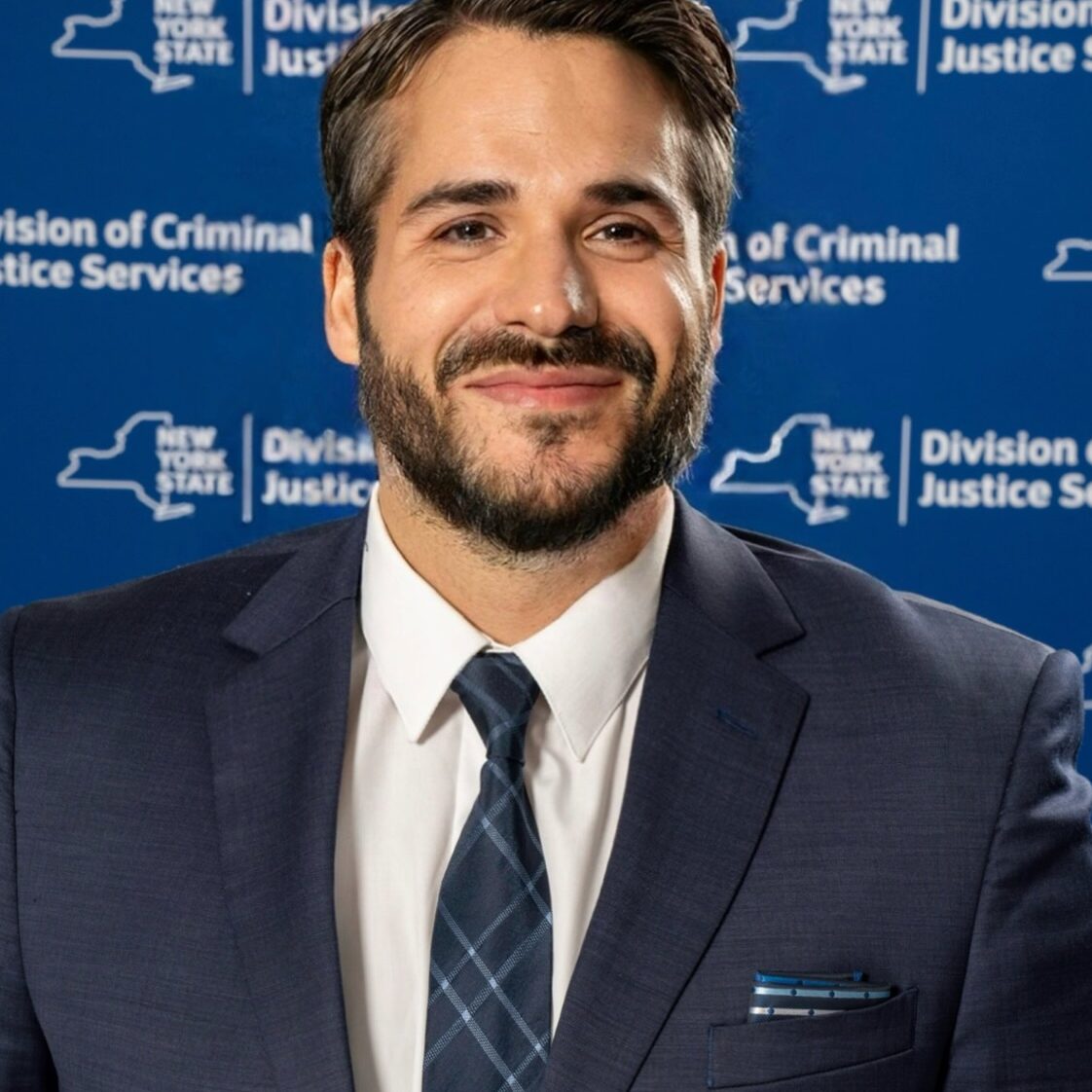
Evidence-Based Policing Hall of Fame
Ryan Perlongo
Inducted May 2026
Nominated by Raymond Neves (New York State Division of Criminal Justice Services), William Forrester III (Walden University), and James Assmann (Director of Public Safety, CUNY York College)
Biography:
Ryan Perlongo is Chief of Evidence-Based Training and Innovation for the New York State Division of Criminal Justice Services (DCJS). In his role, he directs the Evidence-Based Training and Innovation unit, which designs, delivers, and conducts training, technical assistance, research, and analysis to statewide law enforcement partners, equipping them with tools to implement, measure, and sustain evidence-based practices. This includes providing direct assistance to the state's largest inter-agency criminal justice projects, including the flagship Gun Involved Violence Elimination (GIVE) and Statewide Targeted Reductions in Intimate Partner Violence (STRIVE) programs. Perlongo also served as Assistant Chief of Police Services at the State University of New York. He holds an M.S. in Law Enforcement and Public Safety Leadership from the University of San Diego and is a doctoral candidate in the Doctor of Law and Policy program at Northeastern University. He is a 2022 NIJ LEADS Scholar, a 2023 NPI Executive Policing Fellow, the 2024 recipient of the ASC Innovation in Policing Award, and the 2025 recipient of the Gerhard O.W. Mueller Innovator Award from the Northeastern Association of Criminal Justice Sciences.
Evidence-Based Research and Practice:
Perlongo is recognized for his efforts to implement evidence-based policing infrastructure within the New York State DCJS and across the over 500 agencies it serves. As nominator Raymond Neves highlights, Perlongo is responsible for developing and delivering DCJS's growing evidence-based policing content on violence reduction efforts, organizational change, and implementation. He has developed an "implementation sandwich" approach for institutionalizing evidence-based policing through training and organizational assessment. The top of the sandwich focuses on securing leadership buy-in through executive meetings on implementation progress, workshops on evidence-based decision-making, and orientation sessions to set expectations and accountability at the leadership level. At the bottom of the sandwich, building core competencies through an evidence-based training portfolio that ranges from roll-call-length instruction to full-day, problem-oriented policing sessions, tailored to each agency's specific needs. The “meat” of the sandwich is institutionalization, driven by regionally based Field Advisors and Anti-Violence Coordinators, who provide the localized, differentiated support that agencies need to maintain evidence-based strategies over time. This sandwich approach is anchored by the Implementation Assessment Tool, a fidelity instrument that Perlongo created that provides agencies with a structured, ongoing way to assess, adjust, and improve their performance against evidence-based implementation standards.
In total, these efforts have supported two of New York State's largest public safety initiatives: Gun-Involved Violence Elimination (GIVE) and Statewide Targeted Reductions in Intimate Partner Violence (STRIVE). This year, Governor Hochul announced that GIVE jurisdictions recorded the lowest levels of gun violence on record, with a 61 percent statewide reduction since 2021. In the STRIVE program, efforts by Perlongo and others at DCJS have led to the successful development of infrastructure and guides for the long-term implementation. In its first year, more than 1,200 public safety professionals were trained in evidence-based, trauma-informed approaches to domestic violence response.
Statement from Inductee:
The researchers and practitioners in this Hall of Fame are among the most rigorous and consequential thinkers in public safety, and being recognized among them is deeply humbling.
Early in my career, introducing evidence-based practices within my organization meant navigating a difficult path: fighting for a single advocate, receiving far more noes than yeses to ideas, improvements, and suggestions, learning to connect research and efficiencies to existing decision-maker priorities, and using that success as a proof of concept to build greater openness to EBP.
As I moved into leadership, my work shifted away from individual strategies and toward the processes and systems that sustain them, which drew me to implementation science and to training approaches rooted in adult learning and intrinsic motivation. I wanted to drive sustainability and knowledge transfer to keep the train running. At DCJS, we are fortunate to have leaders who support evidence-based strategies to guide our initiatives. When our assessments showed varying levels of success across agencies that used similar strategies, it became clear that many of the challenges and opportunities lay in the process. My goal was to infuse the best evidence on implementation into that oft-forgotten component. That has meant building a mixed-methods perspective, informed by multidisciplinary data on how this work operates in the field, and using it to structure support for jurisdictions in ways that are grounded in real-world constraints. Thinking in systems and working toward a shared problem-solving language has created inroads that sharpen how the work gets done.
DCJS has given me the opportunity to pursue that work at scale. Its leadership has created the conditions for this kind of work to thrive, but it is my colleagues who serve as the driving force behind the success we have seen throughout New York State. Together, we work alongside agencies, coordinators, researchers, and partners across the criminal justice system to build the conditions under which evidence can actually take hold.
The NIJ LEADS Scholar Program and the National Policing Institute Executive Fellowship have connected me with like-minded, brilliant people across this field, many of whom I am now fortunate to call friends and who have pushed my thinking further than I could have on my own.
I want to close by thanking my nominators. Raymond Neves has worked alongside me for a decade. His friendship, stewardship, and kindness are the glue that keeps our unit together. Dr. William Forrester and Dr. Jennifer Hall came into my life through the LEADS program and have become collaborators, confidants, and close friends who continue to challenge, support, and deepen my commitment to innovation. Chief James Assmann gave me my first real opportunity to lead and has never stopped believing in what I am trying to build. Each of them has helped shape the path that brought me here and the one I hope we continue to forge together.
Some of the most consequential work in this field still lies ahead. I am grateful to be part of that work and committed to contributing in ways that are useful, practical, and durable.
Contributions to Grants, Publications, and Projects:
- New York State Division of Criminal Justice Services. (2025). 2025-2026 Gun-Involved Violence Elimination (GIVE) comprehensive plan proposal guidance document.
- New York State Division of Criminal Justice Services. (2026). Statewide Targeted Reductions in Intimate Partner Violence (STRIVE II) comprehensive plan proposal guidance document.
- Perlongo, Ryan. “Viewpoint: Training to Fill Critical Gaps.” In Jerry H. Ratcliffe, Intelligence-Led Policing, 3rd ed. Routledge, 2025.
- GIVE Self-Assessment Tools (SATs)
- GIVE and STRIVE Implementation Assessment Tools (IATs)
- Safer Streets: Governor Hochul Announces Shootings Down 60 Percent Since 2021
Links: