Evidence-Based Policing Hall of Fame
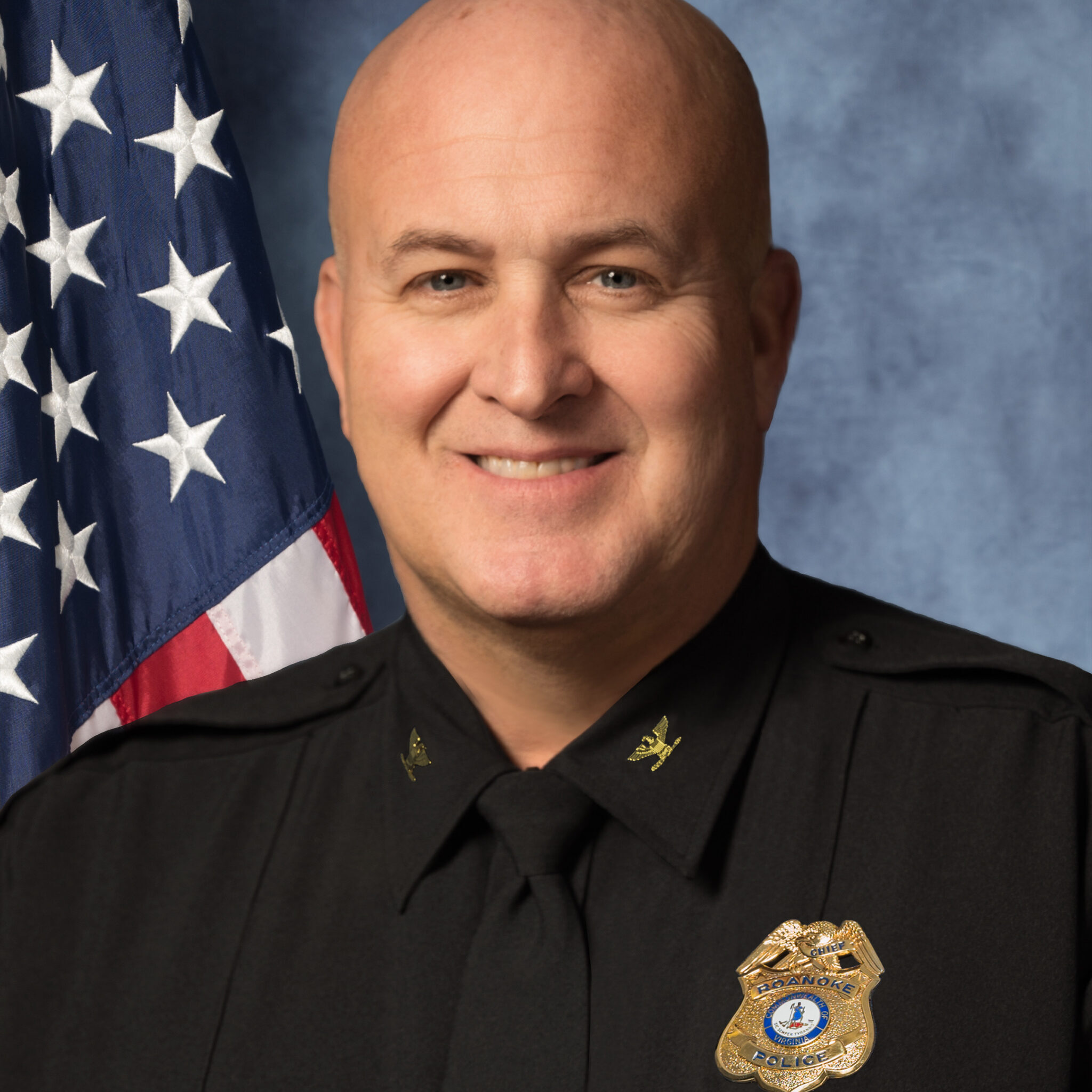
Scott Booth
Inducted May 2026
Nominated by Roberto Santos, Radford University and Member of the Hall of Fame
Biography:
Scott Booth is Chief of the Roanoke (VA) Police Department, where he has served since 2023. He began his career with the Richmond (VA) Police Department in 1996, serving in multiple positions for more than 20 years and retiring as a Major. In 2015, he joined the Metropolitan Washington Airports Authority in Washington, DC, where he served as Deputy Chief of Operations and later as Chief of Police, working with federal partners in the National Capital Region. In 2018, he became the Chief of Police for Danville, Virginia, where he led a focused-policing and community-engagement model, resulting in a 52 percent overall reduction in violent crime in the City. Chief Booth was awarded the Excellence in Policing Award from Radford University’s Center for Police Practice, Policy, and Research, and in 2022, the Excellence in Virginia Government – Innovation in Government Award from the L. Douglas Wilder School of Government and Public Affairs at Virginia Commonwealth University. He holds a Doctorate in Criminal Justice from Pennsylvania Western University, and is a graduate of the FBI National Academy and the Police Executive Research Forum’s (PERF) Senior Management Institute for Police (SMIP). Booth is a proud veteran of the United States Army as well as Operation Desert Storm, where he was awarded the Combat Infantryman’s Badge.
Evidence-Based Research and Practice:
Booth is recognized for his work implementing evidence-based policing in Danville and Roanoke, resulting in significant reductions in crime. Facing historically high levels of violent crime and difficult police-community relationships in Danville, he led a comprehensive organizational shift toward evidence-based policing from 2019 to 2023. Fully implementing the Stratified Policing business model, Booth infused problem-solving, place-based, person-focused, and community-based strategies into the department’s everyday practices and culture. The outcomes in Danville were substantial and sustained over time; clearance rates more than doubled, and the city experienced a 45% decline in violent crime during this time. Compared to other cities in Virginia and the U.S. during this post-COVID period, this was a substantial effect.
In his nomination of Booth, Roberto Santos emphasizes that, as important as these declines were, equally important were the measurable improvements Booth fostered in organizational culture, leadership, accountability, transparency, and police legitimacy and community trust. Danville’s transformation illustrates how structured organizational change, evidence-based strategies, and community engagement can work together to achieve lasting public safety improvements. Through the adoption and careful implementation of Stratified Policing, Scott led the department in a shift from a reactive, call-driven organization to one that prioritizes proactive crime reduction, accountability, and community partnerships.
Booth has carried this commitment to evidence-based policing and the Stratified model to Roanoke, where gun violence has already shown substantial reductions during his tenure. Santos notes that Booth's "leadership has improved public safety, strengthened community relationships, and advanced the profession in ways that are measurable, replicable, and lasting."
Statement from Inductee:
Evidence-based policing is often discussed as a strategy, a framework, or a methodology. For me, it has always been about leadership.
Throughout my career—from the Richmond Police Department, to serving as Chief of Police for the Metropolitan Washington Airports Authority, and later as Chief in Danville and Roanoke, Virginia—I have seen that agencies do not improve simply because they collect more data. They improve when leaders create cultures that value curiosity, accountability, transparency, innovation, and continuous learning. Evidence-based policing is not about replacing experience or instinct; it is about strengthening decision-making with research, analysis, measurement, and honest evaluation.
When I became Chief in Danville, the city was experiencing historically high levels of violent crime, strained police-community relationships, and organizational fatigue. We made a conscious decision to move away from reactive policing and toward a model grounded in evidence, precision, accountability, and collaboration. We embraced data-driven violence reduction strategies, focused deterrence principles, stratified policing, procedural justice, and community engagement built on measurable outcomes rather than rhetoric and photo ops. Over time, violent crime declined significantly, trust improved, and the organization developed a stronger sense of purpose and alignment.
In Roanoke, we continued to build on those lessons by institutionalizing evidence-based policing practices throughout the organization. We focused heavily on reducing gun violence, geographic accountability, offender-focused strategies, de-escalation training, real-time crime analysis, and collaborative partnerships with community stakeholders. Most importantly, we worked to create an organizational culture where innovation and learning were expected—not feared.
One of the greatest misconceptions about evidence-based policing is that it is only about statistics or academic research. In reality, it is about people. It is about using every available tool to reduce victimization, improve legitimacy, support officers, and strengthen communities. Good policing should be both effective and just. The profession should never accept the false choice between public safety and public trust.
One of the leadership frameworks I have often used throughout my career is IMPACT because I believe meaningful and sustainable public safety outcomes require more than traditional enforcement strategies alone. Evidence-based policing works best when it is supported by a clear organizational philosophy and leadership model. For me, IMPACT represents the core principles that guide both my leadership approach and my understanding of effective policing: Intelligence, Measurable Outcomes, Precision, Accountability, Collaboration, and Transparency.
Intelligence means policing must be informed, thoughtful, and proactive rather than reactive. Law enforcement agencies possess enormous amounts of information, but information alone has little value unless it is analyzed, shared, and used strategically. Intelligence-led policing allows agencies to focus resources where they are needed most, identify emerging patterns, intervene earlier, and better protect vulnerable communities. My experience in both municipal policing and transportation policing at the Metropolitan Washington Airports Authority reinforced the importance of intelligence-led policing, interagency collaboration, and proactive threat assessment in both crime reduction and broader public safety operations. I have always believed police leaders should encourage critical thinking and create organizations where analysis and problem-solving are valued as highly as action.
Measurable Outcomes reflects my belief that agencies must honestly evaluate whether their strategies are producing meaningful results. Activity alone is not success. Arrest numbers, traffic stops, and enforcement statistics are only important if they contribute to safer neighborhoods, reduced victimization, and stronger public trust. Evidence-based policing requires leaders to ask difficult questions, embrace evaluation, and remain willing to adjust strategies when the data suggests improvement is needed. Organizations grow stronger when they become comfortable measuring outcomes rather than simply reporting activity.
Precision means focusing efforts where they can have the greatest impact rather than relying on broad or unfocused enforcement approaches. Throughout my career, I have seen that a relatively small number of individuals, locations, and networks are often responsible for a disproportionate amount of violence and harm. Precision policing allows agencies to reduce crime while minimizing unnecessary enforcement and community disruption. It reflects the belief that policing should be focused, constitutional, fair, and rooted in an understanding of underlying problems rather than generalized assumptions.
Accountability is essential to organizational credibility and public trust. Evidence-based policing demands that leaders create cultures where people take ownership of outcomes, decisions, and performance. Accountability is not about punishment, it is about clarity, responsibility, and continuous improvement. Internally, officers and supervisors should understand expectations and feel empowered to solve problems. Externally, agencies must be transparent about their performance and willing to openly discuss both successes and shortcomings. Strong accountability systems strengthen both organizational culture and legitimacy.
Collaboration reflects my long-held belief that policing alone cannot solve complex social problems. Sustainable violence reduction and community safety require partnerships across government, neighborhoods, schools, service providers, businesses, researchers, and community organizations. Some of the most successful initiatives I have been part of were built not through isolated police action, but through multidisciplinary collaboration focused on shared outcomes. Effective leaders recognize that community trust is built through relationships, consistency, and shared ownership of public safety challenges.
Transparency is foundational to legitimacy. Communities are far more likely to trust law enforcement organizations that communicate openly, explain decisions honestly, and demonstrate a willingness to engage during both success and crisis. Transparency requires courage because it often involves sharing difficult information and inviting public scrutiny. Early in my tenure in Danville, following an officer-involved shooting, we made the decision to publicly release body-worn camera footage at a time when that level of transparency was still uncommon. That decision reinforced my belief that openness and honesty, even during difficult moments, are critical to building long-term trust and credibility.
Together, these principles form the foundation of how I view evidence-based policing and organizational leadership. IMPACT is not simply a slogan or management model. It represents a belief that policing can be simultaneously effective, ethical, data-informed, collaborative, and community-centered. I believe the future of policing depends on leaders who are willing to embrace innovation, measure results honestly, build trust intentionally, and remain committed to continuous learning and improvement.
To leaders interested in advancing evidence-based policing, my advice is simple: start by building a culture willing to ask hard questions. Measure what matters. Be honest about what is and is not working. Develop strong partnerships with researchers and analysts. Empower your people to innovate. Most importantly, remember that evidence-based policing is not a program—it is a mindset.
The future of policing will belong to leaders who can combine courage with humility, operational experience with research, and enforcement with legitimacy. Evidence-based policing provides the profession an opportunity to evolve thoughtfully, responsibly, and ethically while never losing sight of our ultimate mission: protecting people and improving the quality of life in our communities.
Being inducted into the Evidence-Based Policing Hall of Fame is deeply meaningful to me because it represents not just individual recognition, but recognition of the officers, analysts, researchers, city leaders, and community partners who helped make this work possible. The best policing outcomes are never achieved alone.
Contributions to Grants, Publications, and Projects:
- Santos, R. G., & Santos, R. B. (2025). Danville, VA Police Department’s implementation of stratified policing and its effects on crime, the organization, and the community [Unpublished draft report]. Office of Community Oriented Policing Services.
- Santos, R. G., & Santos, R. B. (2023). Proactive police response to domestic-related repeat calls for service. Office of Community Oriented Policing Services.
- Booth, S. C. (2022, September). The future of policing is in our shared vision. Police Chief.
- Booth, S. C. (2022). Focused deterrence: Reducing community violence while increasing legitimacy using focused, balanced, and fair police practices [Doctoral research portfolio]. Pennsylvania Western University.
Links: